Privacy-Preserving Audio Deepfake Detection
Research on detecting spoofed speech from privacy-protected audio tokens, so a detection server never has access to what was actually said.
April 2026•completed
Technologies & Skills
PythonPyTorchPyTorch LightningTransformersAudio ProcessingDeep Learning
Project Details
Deepfake detection services usually need the raw audio, which means sending private conversations to a server. This team research project extends the SafeEar framework so detection runs on audio that has been stripped of its spoken content. My work covered the privacy pipeline and its evaluation.
The Approach
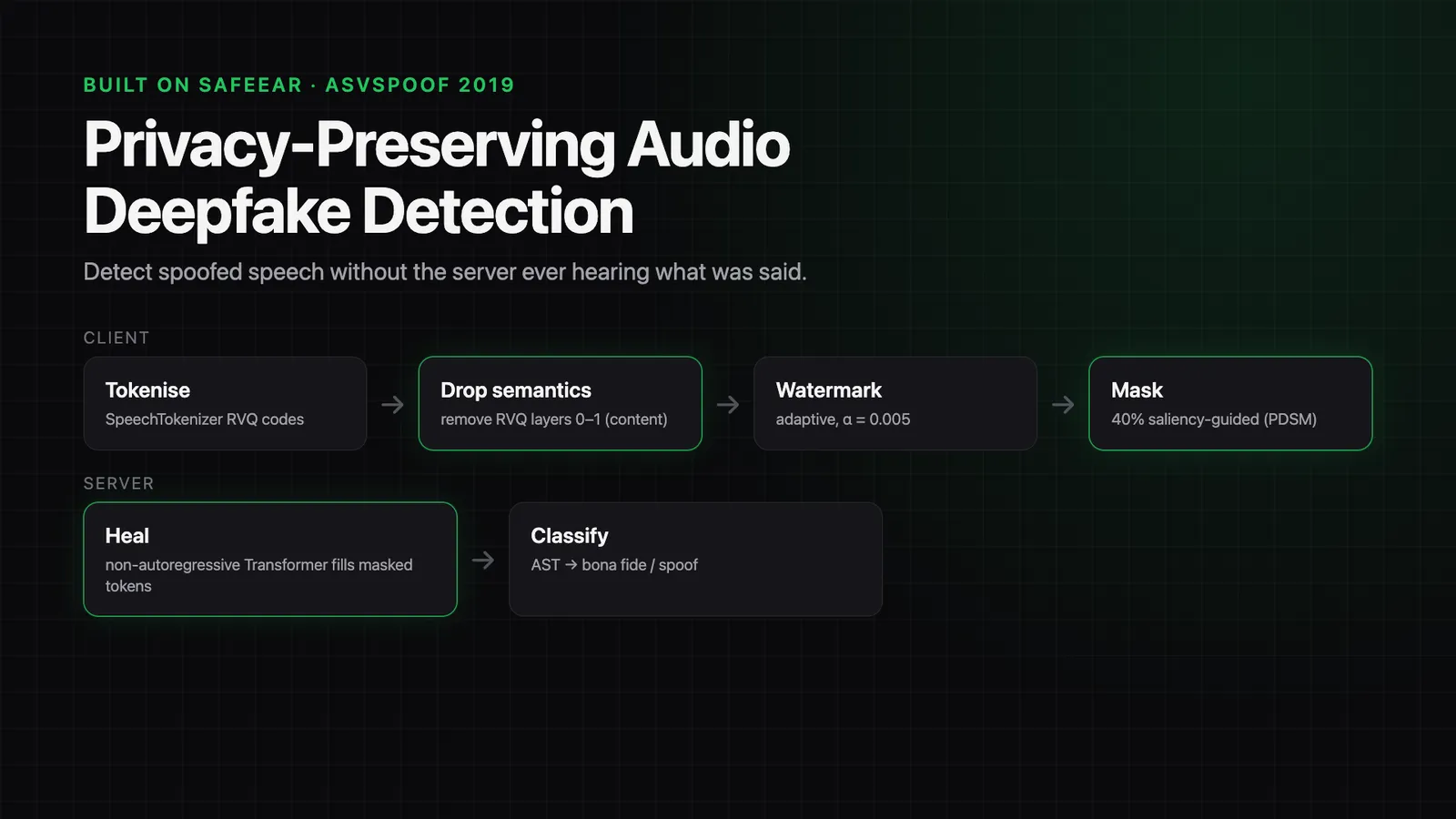
- Tokenisation: Speech is encoded into discrete codes with SpeechTokenizer's residual vector quantiser.
- Removing content: The first two quantiser layers, which carry most of the semantic (word-level) information, are dropped before anything leaves the device.
- Watermarking: An adaptive watermark (α = 0.005) is added to the remaining tokens.
- Saliency-guided masking: 40% of the tokens are masked, chosen by saliency to hide the most revealing regions.
- Healing and classification: On the server, a non-autoregressive Transformer reconstructs the masked tokens and an Audio Spectrogram Transformer classifies the clip as genuine or spoofed.
Results (ASVspoof 2019, 2,000 files)
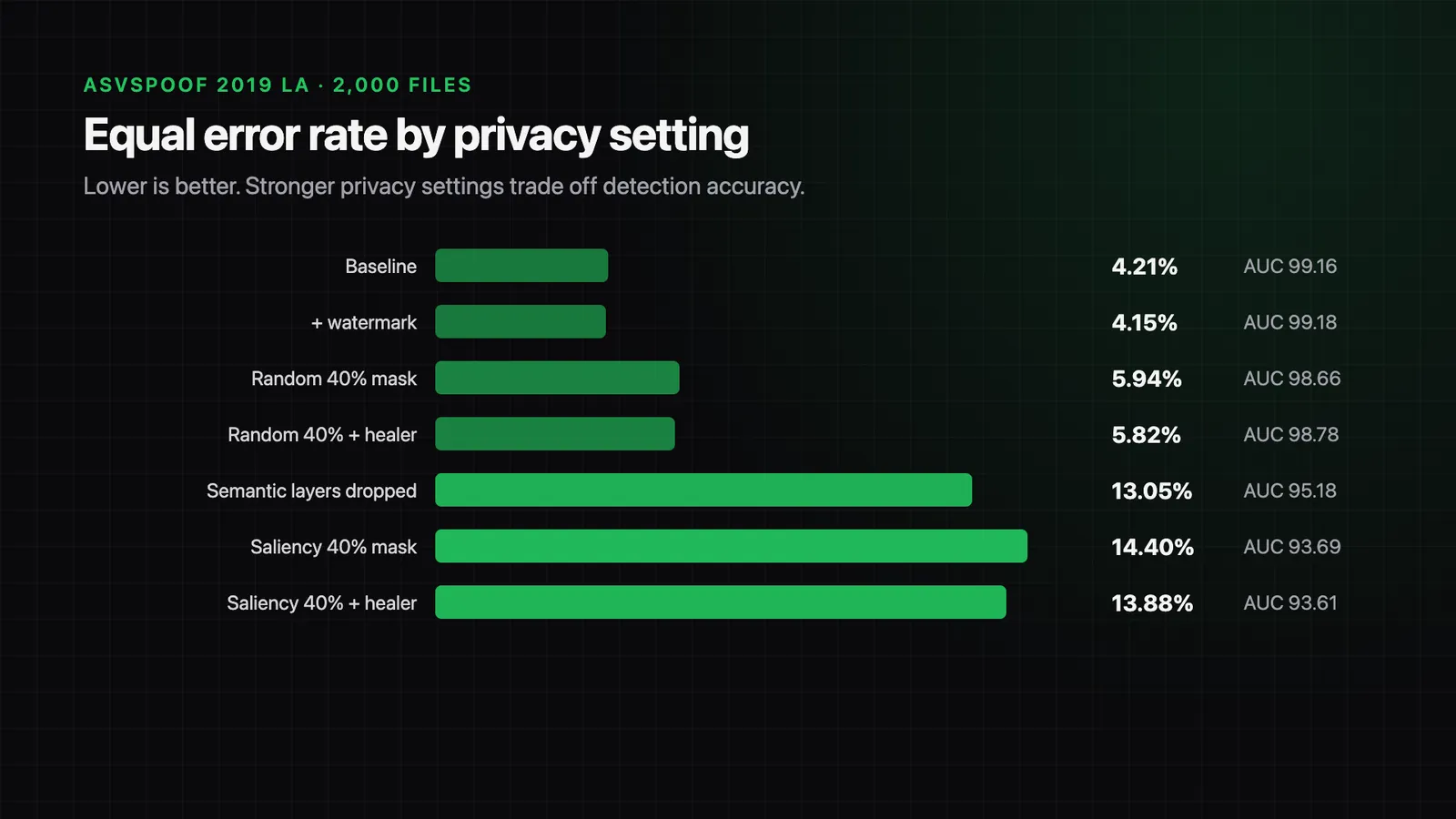
- The watermark is essentially free: EER goes from 4.21% to 4.15% (AUC 99.18).
- With random 40% masking plus the healer, EER is 5.82% (AUC 98.78).
- The strongest privacy setting (semantic layers removed and saliency masking) still reaches about 13.9% EER / 93.6 AUC, making the privacy-versus-accuracy trade-off explicit.
- A Google Lyra codec baseline at 3.2 kbps ran at a real-time factor of 0.025 across about 72k files (PESQ 2.47).