Curriculum Analyzer
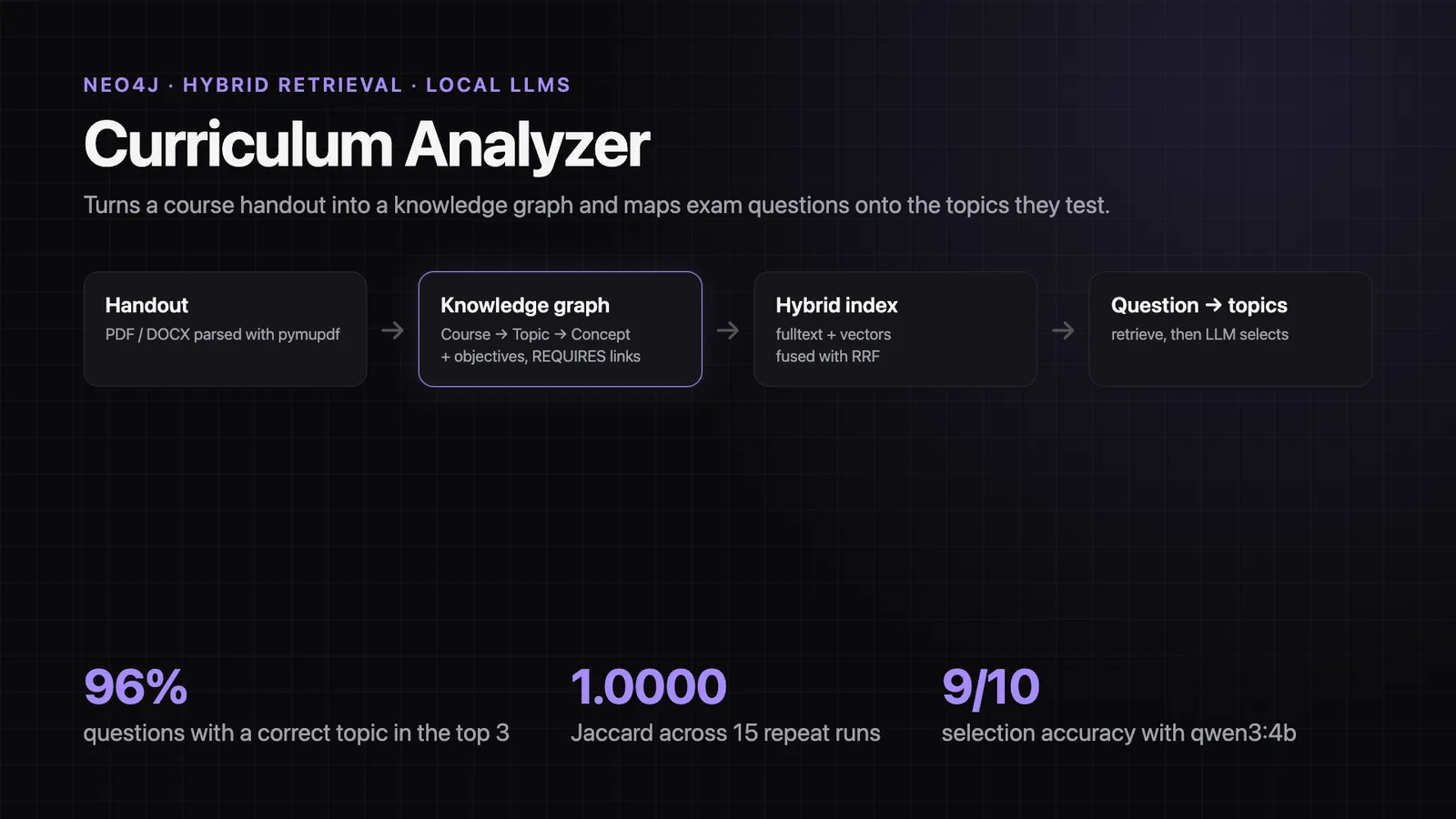
Turns a course handout into a Neo4j knowledge graph, and maps exam questions to the topics they test, all runnable on local models.
September 2026•in progress
Technologies & Skills
PythonNeo4jLLMRAGOllamaGeminiStreamlitPydanticLangfuse
Project Details
Curriculum Analyzer reads a university course handout and builds a knowledge graph of what the course teaches. Exam questions are then mapped onto that graph, so faculty can see which topics a paper covers and which it misses. Built as a team of four; I worked on building the knowledge graph and extracting topics from it.
How It Works
- Handout to Graph: The handout is parsed with pymupdf, which keeps the math glyphs that pdfplumber drops. An LLM extracts a Neo4j graph of
Course → Topic → Conceptwith learning objectives, and a second pass addsREQUIRESandRELATED_TOlinks between topics. - Hybrid Retrieval: Every searchable node is indexed twice, as Neo4j fulltext and as vector embeddings. The two rankings are fused with reciprocal rank fusion, weighting the dense side 1.5×.
- Question to Topics: Retrieval narrows the candidates, then a small local model picks the topics a question actually tests. Questions that fall outside the syllabus are flagged rather than forced onto a topic.
- Figures: Pages with circuit diagrams or plots are detected by counting Bézier curves in the PDF (0 on prose pages, 178 to 525 on circuit pages) and escalated to a vision model.
- Swappable Models: Graph extraction, topic selection and embeddings are separate roles, each with its own provider. Everything runs locally on Ollama (qwen3:4b, mxbai-embed-large), with Gemini as an option for graph extraction.
Results
- 96% of questions have a correct topic in the top three.
- 1.0000 mean Jaccard similarity across 15 repeat runs, so the same paper always maps the same way.
- 9/10 topic-selection accuracy with the 4B-parameter qwen3 model.
- The CS F111 handout produces 13 topics, 79 concepts and 48 learning objectives.
Tooling
A Streamlit app (Build, Inspect and Ask tabs) and a CLI (build, index, ask), with Langfuse tracing, structured logging, pytest, ruff and ty.